



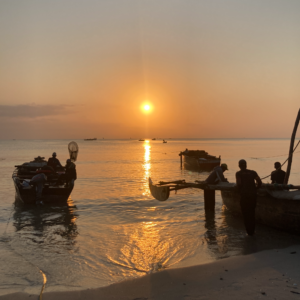
16-year-old Lidya explores how climate change is impacting agricultural and fishing activities in Tanzania
“The waves are stronger and harder to predict, especially at night. Sometimes strong winds and sudden rain will actually stop us from fishing,” says Hassan Ally, a Tanzanian fisherman with almost 30 years of experience on the water.
As the sun sets over Bagamoyo, a historical coastal town 65km north of Dar es Salaam, tired fishermen return from the ocean with nearly empty nets. Among them is 50-year-old Ally who, defeated, wipes the salt from his face after a long, rough night.
Harbingers’ Weekly Brief
Subscribe to the Harbingers’ Weekly Brief, a newsletter written by the editorial board of Harbingers’ Magazine, the world’s youngest newsroom, delivered to your inbox every Monday morning.
![image]()
![slide image]()
![image]()
![slide image]()
![author_bio]()
![author_bio]()


Out on the open ocean, Hassan and others like him face challenges they never imagined years ago. “The water is warmer now, so the fish move deeper,” he says. “Waves are stronger and sudden rains often stops us from fishing.”
Hassan has seen how the ocean that once sustained them is now harder to depend on. Changes in weather patterns and human activities along the coast have affected marine life and made fishing more difficult.
Fishing
One of Tanzania’s oldest and most important economic activities is fishing. More than 200,000 Tanzanians earn their living from fishing and another four million work as fish traders, boat controllers or in fish processing. For many people living along the coastline, fishing is not a job – it is life itself.
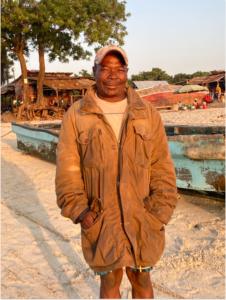
Hassann Ally in Bagamoyo after a long night’s fishing.
Small-scale fishing involves using simple tools such as nets and dhows or small boats. This practice sustains thousands of citizens across the country and allows them to earn a living. Large-scale fishing involves modern vessels and focuses on exports to other countries, or selling in larger domestic markets.
The fishing sector not only supports local economies, but also contributes to government revenue. Men and women both play significant roles: men often fish, while women wash, dry, smoke or sell the fish – jobs sometimes also done by young people.
However, the sector faces major challenges such as overfishing, illegal fishing, water pollution, and weak enforcement of fishing regulations. These issues threaten marine ecosystems and the livelihoods of those who depend on them.

As Hassan explains, fishing has also been hit hard by climate change.Changing weather patterns have made it increasingly challenging for fishers to earn a living and have put both their safety and livelihoods at greater risk.
Hassan says safety at sea has also declined. “The Tanzanian government decided to cut safety for people who are going to fish at night or during the day,” he tells me. He says that the people who were given the power to implement boat safety regulations are not taking their duties seriously.
“They don’t actually use it to save people’s lives. The citizens are also disappointed because the government trusts wrong people who just care about their lives and family safety. If they could train us on new fishing methods or give us better tools, we could survive,” he says.
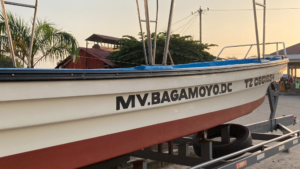
Agriculture
The climate crisis affects not only the fishing sector, but also farming.
More than four million Tanzanians are engaged in crop cultivation and contribute significantly to the country’s GDP (gross domestic product) and export earnings. Agriculture also supports the country’s export earnings through cash crops, provides raw materials for local industries such as textiles and food processing, and sustains rural infrastructure and livelihoods.
It is often said in Tanzania, “Kilimo ni uti wa mgongo wa uchumi” – “Agriculture is the backbone of the economy.”
In the highlands of Lushoto, a town in the Usambara mountains in north-east Tanzania, Hoza Kaniki, a 68-year-old farmer with almost two decades of experience, says: “Sometimes [the land is] flooded, sometimes it’s dried completely. This affects my income – no harvest in food crops or cash crops.”
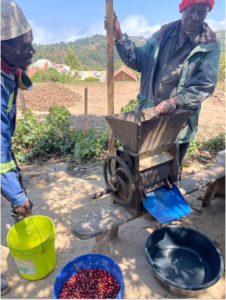
Yusuph (left) and another farm worker.
Kaniki’s annual income is low, about nine million Tanzanian shillings (roughly $3,700), which only covers his daily expenses. His words reflect the challenges faced by farmers across Tanzania.
In the past, Tanzanian farmers used traditional methods in agriculture. They would use simple tools like hoes and rely on climate conditions, mostly rainfall, to grow crops. Small-scale farming could feed their families.
But today, climate vulnerability has disrupted this rhythm. Changing weather conditions directly affect production. Farmers are struggling with prolonged droughts and sudden floods. These conditions reduce yields, threaten food security and make farming more difficult.
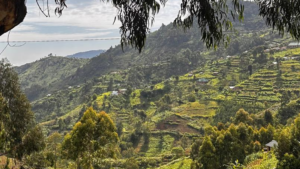
Pests and diseases have also worsened. “Pests and fungus are very common in my land,” says Kaniki. “The local solution is to use knowledge – organic methods like planting desmodium plants and elephant grass quickly pushes stemborer moths away from the maize.” This is part of the ‘push-pull’ farming system, which is a climate-friendly method of pest control.
From the coastlines of Bagamoyo to the farms of Lushoto, Tanzanian workers are facing growing risks from the changing climate. As their environments transform, so do the jobs, incomes and traditions that sustain millions of families.

Edited by:

© 2026 The Oxford School for the Future