



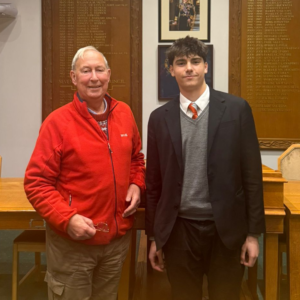
16-year-old Lukas interviews Tony Clayton about youth under-representation in politics
Young people are consistently under-represented in politics globally, and social media misinformation is one of the key reasons behind this trend, thinks Tony Clayton, mayor of the town of Sevenoaks in Kent, UK.
“There is this polarisation and echo chamber effect, which means that people stop listening to each other,” the mayor said in an exclusive interview with Harbingers’ Magazine.
Harbingers’ Weekly Brief
Subscribe to the Harbingers’ Weekly Brief, a newsletter written by the editorial board of Harbingers’ Magazine, the world’s youngest newsroom, delivered to your inbox every Monday morning.
![author_bio]()
![author_bio]()


Forming an unbiased political opinion is becoming increasingly harder in the digital age. Algorithms on large social media platforms such as Instagram, X and TikTok often place users into echo chambers, reinforcing existing beliefs and deepening political polarisation.
One example could be the so-called “red pill” algorithm, which promotes extreme content by steering users towards a narrow and misogynistic worldview. As a result, political debate becomes more hostile and less constructive.
The mayor also points to a lack of “political understanding” as a barrier to youth engagement.
Low voter turnout among young people remains a key issue. Because young voters participate less, their concerns carry less political weight. In the UK, turnout among voters aged over 66 exceeds 88%, compared with around 65% of 18- to 25-year-olds. It is therefore no surprise that legislation increasingly reflects the priorities of older generations.

Political power, Clayton said, is influenced by participation. “The best decisions are taken closest to the people… you get much, much better decisions,” he said, emphasising the importance of local engagement and accountability.
That is why the mayor is in favour of participatory democracy– a system where people are directly involved in decision-making, rather than only voting every few years. Such approaches, he argues, allow young people to have a real impact on the policies that affect their daily lives.
Take, for example, the Youth Council in Sevenoaks, whereby under-18s can actively help with decision-making such as building new social spaces and cafés, and helping within the local park.
“Putting your cross on a ballot paper is a pretty blunt instrument to get stuff done,” he said.
For some young people, politics can appear to be an attractive career path, offering the chance to work in a team to solve real-world problems, manage public services and help out local communities. However, Clayton warns against entering politics too early. “Part of the problem with politics is that there are too many people in it who have never done anything else,” he said.
Clayton was elected mayor of Sevenoaks in May 2025, having first joined the town council in 1987 and previously serving as mayor in 1995/96. An economist by profession, he has worked in senior roles in the UK civil service, including at the Office for National Statistics and the UK Intellectual Property Office, and later as a consultant.
He advises aspiring politicians to gain experience outside the political sphere first. “My strong advice would be: don’t go into politics as a full-time profession first.” A different career, he argues, provides a “broader view of the world” and leads to more informed and effective decision-making.
Ultimately, youth participation in politics goes beyond simply voting. As Clayton highlights, misinformation, low turnout and limited political understanding continue to distance young people from decision-making processes. However, through greater engagement and participatory democracy, young people can play a more active role in shaping policies that directly affect their futures.

Edited by:

© 2026 The Oxford School for the Future