



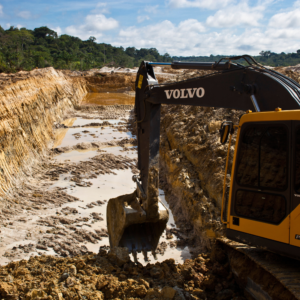
17-year-old Jennie reveals the dangers illegal mining poses to the Amazon and its peoples
The world breathes as the Amazon exhales. This is the philosophy of the Western world, the simplified poetry of conservation. The rivers carry sediment, memory and movement from Peru to Brazil.
Thousands of species native to the forest are found nowhere else on Earth, and spiritual geographies belonging to hundreds of Indigenous tribes flourish along the waterway. To these peoples who have called its depths home, the rainforest is the grammar of their existence: the source of every story, every medicine and every god.
This elegant image of undisturbed tribes living in harmony with nature has become a powerful emblem for environmentalists. It suggests a simple equation: protecting the tribes is protecting the forest. Yet this relationship conceals a far more complex and urgent dilemma.

As national governments draw borders on maps to create conservation parks, outside forces press against ancient territories through illegal miningand oil concessions, a profound question emerges: are we trying to save the Amazon, or are we trying to save an idea of it? And when the continuity of a culture depends on a landscape that is being actively unmade, what are we truly trying to preserve?
The Amazon spansroughly 6.7 million sq km across nine South American countries with its rivers supplying nearly 20% of the world’s riverine freshwater to the oceans. It is estimated that one in ten known species on Earth lives in the basin. Far from a static wilderness, the Amazon functions as a vast and dynamic ecological engine.
Brazilian archaeologist Eduardo Góes Neves’ recent research suggeststhat the forest was densely populated over eight millennia ago, long before European ambition reached South American soil. In traditional Indigenous folklore native to this land, the Amazon and the Andes together formed a formidable ecological barrier to colonial expansion.
Of the hundreds of Indigenous groups living within the Amazon basin, communities such as the Yanomami, the Kayapó and the Wampis Nation occupy territories that function simultaneously as cultural archives and ecological strongholds. For these communities, geography is inseparable from identity.
Archaeological evidence indicates that many parts of the Amazon were shaped by centuries of Indigenous land management, including controlled burning, agroforestry systems and soil-enrichment techniques such as terra preta (‘black earth’ in Portuguese). The forest’s apparent wildness contains traces of deliberate cultivation.
Today, in the present, the Amazon is no longer only shaped by the slow rhythms of rivers or the seasonal logic of fire. Increasingly, human ambition is reshaping the fate of the forest, often at the expense of biodiversity and Indigenous cultural heritage.
Mining of protected areas
Industrial mining has long extracted minerals such as iron, bauxite and gold through large-scale regulated operations. Over the past decade, however, a far more destructive form of mineral extraction has expanded rapidly. Known locally as garimpo, these small-scale and often illegal gold-mining operations have spread across protected and Indigenous territories. In 2022 alone, the area occupied by garimpo in the Brazilian Amazon reached about 2,630 sq km – an increase of roughly 341 sq km from the previous year – and nearly 848 sq km larger than the footprint of regulated industrial mining.
Harbingers’ Weekly Brief
Subscribe to the Harbingers’ Weekly Brief, a newsletter written by the editorial board of Harbingers’ Magazine, the world’s youngest newsroom, delivered to your inbox every Monday morning.
![author_bio]()
![author_bio]()


Garimpo operations rely heavily on mercury to separate gold from river sediment. This process, known as mercurial amalgamation, involves mixing mercury with ore so that it binds to gold particles. The contaminated wastewater is then released into waterways and soils, where it transforms into toxic methylmercury, accumulating in animals and entering food chains critical to both native biodiversity and human health.
From above, the expansion of illegal mining is unmistakable. Satellite monitoring programmes such as Brazil’s MapBiomas and the Instituto Socioambiental reveal widening bands of deforestation radiating along tributaries of the Tapajós and Madeira rivers. Floating dredging rigs anchor to riverbeds and convert dense forest margins into exposed sediment fields visible from orbit.
To make matters worse, in Brazil’s Yanomami territory, investigations have linked illegal miners to armed attacks on villages and the forced displacement of families living along key river routes used by mining supply chains.
View this post on Instagram
Political ambiguity
These illegal incursions are rarely spontaneous. They are organised, financed and often shielded by political ambiguity. In regions where state presence is selective or absent, paramilitary groups and criminal networks exert control, turning Indigenous lands into contested frontiers.
Many state-led conservation efforts, such as Brazil’s Amazon Region Protected Areas Program (ARPA) and Peru’s network of national reserves, struggle against competing economic pressures. Protected areas and Indigenous territories are formally demarcated, yet portions of these same regions are simultaneously subject to mining concessions, oil blocks or infrastructure approvals issued by national governments.
Brazil’s Forest Code requires preservation quotas on private land, while Peru’s Law of Prior Consultation mandates consultation with Indigenous communities before extractive projects proceed. Yet enforcement across the basin remains inconsistent.
Monitoring groups such as SOS Orinoco in Venezuela, which tracks illegal mining and armed activity throughout the Amazon basin, report that protected territories frequently become entry points for informal mining economies and cross-border criminal networks.
The contradiction is visible across maps of the basin. Conservation zones, Indigenous territories and mining concessions frequently overlap, producing what researchers describe as a fragmented governance landscape. Legal boundaries intended to preserve biodiversity often intersect with contracts authorising extraction, leaving protection dependent on enforcement that remains uneven across the region.
Yanomami leader Davi Kopenawa has warned that the forest cannot be separated from the people who inhabit it: “If the forest dies, we will die with it.”
This stark reality exposes the limits of conservation frameworks that exist largely on paper while extractive industries continue to advance.
Across parts of Latin America, a political shift towards resource-driven development has further complicated this balance as governments attempt to reconcile conservation commitments with economic growth.
But for Amazonian communities, the forest has increasingly become a perimeter under siege. For them, conservation surpasses an environmental concern and becomes a struggle for survival, the erosion of governance systems and cultural continuity. Territory functions as a cultural lifeline: rivers organise trade routes, forests anchor cosmology, and medicinal knowledge remains inseparable from the landscape itself.

Edited by:

© 2026 The Oxford School for the Future