



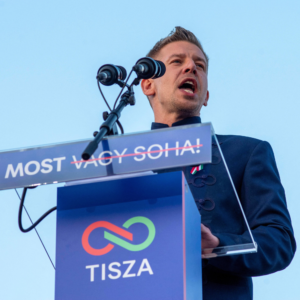
17-year-old Lola analyses the main challenger to Viktor Orbán in this weekend’s election
As Hungary’s election on 12 April nears, it is clear that the main competitors are Prime Minister Viktor Orbán’s Fidesz party, which has been in power since 2010, and the Tisza party led by Péter Magyar.
It has been described as “Europe’s most consequential election of the year”, with many leaders in the European Union and elsewhere keenly awaiting the outcome.
Currently, Orbán runs the country as an “illiberal” democracy, standing against multiculturalism and promoting traditional family values. On the other side is Péter Magyar. While both parties sit on the right, they differ significantly.
Harbingers’ Weekly Brief
Subscribe to the Harbingers’ Weekly Brief, a newsletter written by the editorial board of Harbingers’ Magazine, the world’s youngest newsroom, delivered to your inbox every Monday morning.
![slide image]()
![author_bio]()
![author_bio]()


Fidesz is a far-right party that over the past decade and a half has drawn criticism from the EU due to concerns over the rule of law, leading to the suspension of €18bn in EU funding.
Meanwhile, Magyar’s centre-right, pro-EU Tisza party attracts a mix of both liberal and conservative supporters.
Recent polling indicates a shift in support, with 56% of decided voters backing Tisza compared with 37% for Fidesz, while 26% of respondents remain undecided.
Orbán has not been challenged to this extent since he first gained power, which makes the figure behind this shift most interesting: Péter Magyar.
Magyar’s rise to prominence
Péter Magyar, 45, is a father of three sons, the leader of the Tisza party, and a former party member and insider of Orbán’s Fidesz.
He has shown an interest in politics and public service since childhood, and studied sociology and political science at Pázmány Péter Catholic University.
His political career began in 2010 when he became the EU’s law officer at the Hungarian Ministry of Foreign Affairs and Trade. Later he held various positions, including roles connected to the Prime Minister’s Office and Hungary’s relationship with the European Parliament.
In early 2024, Magyar’s public profile soared after a scandal about a controversial presidential pardon. Then-president Katalin Novák had granted clemency to an individual involved in a child abuse case, which caused widespread public outrage.
The situation became more politically sensitive as Judit Varga, the former justice minister and Magyar’s ex-wife, countersigned the pardon and therefore held political responsibility. She also resigned shortly after Magyar made the information public.
This case raised broader concerns over accountability, particularly as figures linked to the decision faced limited consequences.
Later in 2024, Magyar joined and became the leader of the formerly dormant political party, Tisza. Since then, he has toured Hungary multiple times over to promote the party, especially in rural areas, where Fidesz has traditionally had strong support.
An estimated half a million people gathered at Magyar’s rally in Budapest on 15 March, a national holiday celebrating the Hungarian revolution against the Austrian Empire.
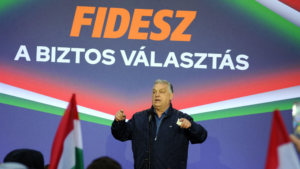
Tisza’s increased influence
Under Magyar’s leadership, Tisza has grown from being a small and irrelevant party on the national scale to the main opponent of the dominant party that has been in power since 2010.
It could be argued that Magyar’s popularity is simply a case of luck and good timing, but the Hungarian people’s discontent with the current government runs deeper now than ever, and goes beyond an interest in a political newcomer.
Orbán’s authoritative leadership benefits only those who support his party, which makes up only a third of the electorate. He often boasts that Hungary has some of the best life quality within the EU, but this rhetoric disagrees with the realities of rundown roads and insufficiently equipped hospitals and schools.

After Magyar’s very public disapproval of Fidesz, he faced many media attacks from Fidesz, which motivated him to run in the European elections in June 2024.
By this point, Magyar had received tons of media attention (both derogatory and celebratory), so when he joined the Tisza party he was immediately able to turn it into a PR success. To garner interest outside of the media and connect with the public, he held hundreds of rallies all over the country.
As a result, Tisza was able to garner nearly 30%of the vote in the EU elections, while support for Fidesz dropped to 44%.
Since then, Magyar has faced more media scandals, yet he remains supported by the general public.
Magyar’s promises of change
Magyar has stated that he aims to “tackle corruption” and rehabilitate the country’s struggling economy, along with establishing a “functioning and humane” Hungary.
Many Hungarians feel there is a strong need for this, as economic disparity remains a huge problem in the country. One way he plans to address this is by unlocking the billions of euros of EU funding that have been frozen due to concerns over Hungary’s rule of law. These funds, he argues, could be used to improve education and healthcare systems, which have long faced challenges.
For younger voters, education is particularly relevant. In recent years, public education institutions have struggled, with teachers protesting over low pay and working conditions. Notably, when Fidesz took power in 2010, they closed the Ministry of Education and instead integrated it into the Ministry of National Human Resources, which does not specifically focus on education.
In 2023, a law was passed that changed teachers’ employment status, placing them under a new legal framework for public education workers.
A key part of Magyar’s programme is increasing teacher wages by 25%, which he argues would support broader reforms in the education system. He has also proposed tax reductions for minimum wage workers and increases in pensions.
View this post on Instagram
Why do people support Magyar?
Some supporters see Magyar as a figure of change and “great hope”. His background as a former Fidesz insider allows him to position himself as someone who understands how the system works while also criticising it.
His decision to speak out against the government has contributed to a perception among supporters that he could bring greater transparency and accountability.
His campaigning style has also attracted younger voters. Compared with Orbán, he presents himself as more accessible and active, using social media and public appearances to engage with voters.
At the same time, his personal and political trajectory has not been without controversy, including tensions surrounding his past relationship with Judit Varga, which have drawn public attention.

Edited by:

© 2026 The Oxford School for the Future