


16-year-old Jennifer recounts the most memorable moments of the tournament so far
The FIFA 2026 World Cup is in full swing, and tension is skyrocketing. The group stage is now over, and the 48 teams that started the tournament have been whittled down to 32.
The knockout stage started on Sunday 28 June – now, there are no more second chances. If a match is still tied after 90 minutes, the teams play an extra 30 minutes. If it is still tied, a penalty shootout determines who comes out victorious.
There are five rounds in the knockout stage: the round of 32, the round of 16, the quarter-finals, the semi-finals and the final, to be held in New Jersey on 19 July.
Harbingers’ Weekly Brief
Subscribe to the Harbingers’ Weekly Brief, a newsletter written by the editorial board of Harbingers’ Magazine, the world’s youngest newsroom, delivered to your inbox every Monday morning.
![slide image]()
![author_bio]()


The group stage proved that nothing is predictable. Between the chaos, joy and disappointment, fans should expect even more unforgettable moments as the road to the trophy begins to narrow.
The knockout stage is where the World Cup truly comes to life. In the meantime, here are some moments that stole the show during the group stage.
Surprise results
- The Democratic Republic of the Congo were expected to lose to Portugal, but forced a shock 1–1 draw, winning their first ever World Cup point.
- Ghana, ranked no. 65, managed a scoreless draw against one of the World Cup’s frontrunners, England.
- Türkiye entered the tournament as a potential dark horse, but suffered from two disappointing losses, leading to an early exit.
- The Netherlands, supposedly one of the strongest teams, weren’t able to get past Japan in a thrilling 2–2 draw.
- Ecuador caused one of the biggest upsets so far, coming from behind to defeat four-time World Cup winners Germany 2–1 in a stadium turned yellow by the ecstatic South American fans.
Messi breaks more records
Known for his ankle-breaking dribbling, precise passing and unworldly goal-scoring ability, Argentina’s Lionel Messi is arguably the best football player in the world. He lived up to his reputation in his team’s group matches.
The eight-time Ballon d’Or winner scored every goal in Argentina’s 3-0 victory against Algeria. Against Austria, Messi missed a penalty in the eighth minute, but 30 minutes later scored his 17th World Cup goal, surpassing Germany’s Miroslav Klose as the tournament’s top scorer. He then scored another in stoppage time, further etching his name into history.
He scored again from a free kick in Argentina’s final game, against Jordan, bringing his total to 19 goals. That broke another record: Messi – who turned 39 on 24 June – is the first person to have scored in seven consecutive World Cup matches.
All hail the Tartan Army
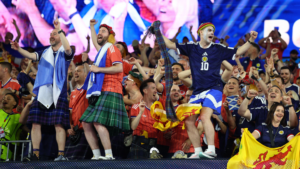
The World Cup has drawn football fans from around the world but Scotland’s supporters have garnered the most attention. An estimated 50,000 to 60,000 fans, known as the Tartan Army, travelled to the US to witness their country’s first World Cup appearance in 28 years, since France 1998.
Their presence has been hard to miss, with kilts, bagpipes and Scottish flags filling the streets of Boston. Their celebrations were so lively that local pubs and bars reportedly ran short of beer. Jokes aside, the Tartan Army made multiple donations to charities in Rhode Island including teaching local children how to play the bagpipes.
Their impact was so immense that Boston mayor Michelle Wu established a formal sister city partnership with Glasgow, Scotland’s largest city.
Sadly, Scotland failed to reach the knockout stage, but their positivity will be forever remembered.
Cape Verde’s standout debut
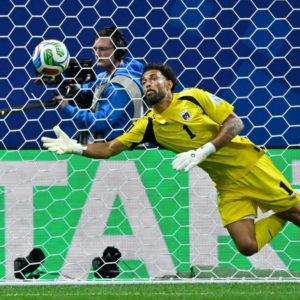
Cape Verde – and particularly the team’s 40-year-old goalkeeper Vozinha – proved that underdog stories never get old.
The tiny island nation of just over half a million, situated about 500 km off Africa’s west coast in the middle of the Atlantic, faced Spain in its first match. No. 67 in the FIFA rankings versus no. 2; a World Cup debutant versus the European champions and one of the tournament’s favourites.
They managed to hold Spain to a 0–0 draw, a result that felt like a win.
Much of that success was down to goalkeeper Vozinha (full name Josimar José Évora Dias), who made seven official saves and delivered a crucial stop in the 39th minute.
Afterwards, Vozinha was moved to tears, both by the result and by the fact that his mother wasn’t at the game because she couldn’t afford a visa. His story resonated with fans and his Instagram following has surged from 50,000 to more than 17 million. With the help of supporters and officials, his mother secured a visa for Cape Verde’s next game.
The fairy tale continues: after drawing all three of its group stage games, Cape Verde finished second in their group and now face defending champions Argentina on 3 July.
Hydration breaks face backlash
Football is a game of two 45-minute halves without breaks. Except at the 2026 World Cup, which introduced a new rule: hydration breaks. Midway through each half, play pauses for a mandatory three-minute break.
It’s similar to a timeout, which is common in US sports such as American football and basketball. FIFA claimed that the break is to ensure players stay hydrated in the hot summer conditions across North America. But many have objected to the new format, with fans booing loudly at each break.
Some argue that many matches are being held in air-conditioned stadiums, making the rule unnecessary. Others say players are already accustomed to playing in hot conditions elsewhere in the world.
The biggest criticism from fans, players and coaches is that the breaks appear to give broadcasters an opportunity to run commercials. Despite the backlash, FIFA president Gianni Infantino has defended the rule and said there will be no changes for this tournament.
View this post on Instagram
Host countries show dominance
North America may not be the first region that comes to mind when people think about football, but the US, Mexico and Canada are making a statement as co-hosts. Mexico and the US were the first teams in the tournament to advance to the knockout stage.
Mexico topped Group A after winning all three of its games without conceding a single goal: 2–0 against South Africa, 1–0 against Korea, and 3–0 against Czechia. They now face Ecuador on home turf, in Mexico City, on 1 July.
Team USA were second to advance to the knockout stage. They defeated Paraguay (4–1), Australia (2–0) and Türkiye (3–2). As the winner of Group D, they meet Bosnia and Herzegovina on 2 July.
Canada also put in some strong performances, including a 6–0 thrashing of Qatar, but drew with Bosnia and Herzegovina and lost to Switzerland. Ending second in Group B, they were the first team to progress to the last 16, defeating South Africa on 28 June with a goal in injury time.

© 2026 The Oxford School for the Future