


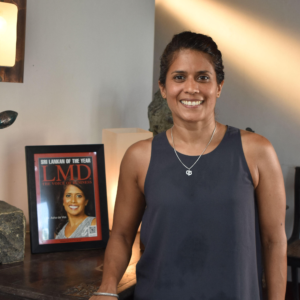
17-year old-Hesandi kicks off a new Harbingers’ series on Women in STEM with a Sri Lankan trailblazer in marine biology
Sri Lankan marine biologist and pioneer of blue whale research in the northern Indian Ocean, Dr Asha de Vos is Sri Lanka’s first deep-sea explorer.
Born in 1979, Dr de Vos moved to Scotland for her undergraduate studies in marine and environmental biology at the University of St Andrews. She later earned her master’s degree in integrative biosciences at the University of Oxford and a PhD from the University of Western Australia.
How did her interests develop?
Her journey started when she was six years old, when National Geographic magazine inspired her to become an “adventure scientist”. Growing up in Sri Lanka, where the ocean was a constant part of her surroundings, she was intrigued by marine life and what existed beneath the surface.
“When I went to university for marine biology, I was pretty hell-bent on the idea of unravelling this mystical magical place,” she saidin an interview.
Her career took a pivotal turn in 2003, when she spotted animal faeces floating to the surface while on a research boat off the Sri Lankan coast. They belonged to a group of six blue whales that De Vos soon realised were not migrating out of the North Indian Ocean, to areas with a richer food supply.
Typically, blue whales migrate long distances from cold feeding areas to warm breeding areas. But these blue whales around Sri Lanka remained in warm waters – considered not food sufficient – throughout the year.
Understanding why and what allowed these whales to behave differently – and to survive – meant that Dr De Vos had to “step out of her comfort zone” (marine biology) and conduct her PhD in an oceanography lab in Western Australia instead.
She dubbed this group of whales “unorthodox whales” as they were an unrecognised unique population. Her research also drew attention to a threat facing this population: ship strikes. She discovered that blue whales were often injured or killed by vessels coming to and from Colombo’s port.
Harbingers’ Weekly Brief
Subscribe to the Harbingers’ Weekly Brief, a newsletter written by the editorial board of Harbingers’ Magazine, the world’s youngest newsroom, delivered to your inbox every Monday morning.
![author_bio]()
![author_bio]()


What has she achieved?
Dr Asha De Vos is the founder and director of Oceanswell, Sri Lanka’s first marine conservation research and education organisation. She is also the first Sri Lankan to earn a PhD in marine mammal research.
In 2008, she founded the Sri Lankan Blue Whale Project, which focuses on the research and conservation of the “unorthodox” whales. Due to De Vos’s research, the International Whaling Commission recognised Sri Lanka’s blue whales as its own subspecies called Balaenoptera musculus indica.
De Vos is a TED Senior Fellow, and has used the platform to spread awareness about blue whales in the northern Indian Ocean. She is also a Duke University Global Fellow in marine conservation, a National Geographic Explorer and a Young Global Leader of the World Economic Forum.
Among her many awards, Dr de Vos has received the President’s Award for Scientific Publication in Sri Lanka (2015); Wings WorldQuest Women of Discovery Sea Award (2018); and the Vanithaabimana Lifetime Achievement Award (2021), which recognises Sri Lankan women who have made exceptional contributions to the country.
View this post on Instagram
Encouraging women in science
Throughout her career, De Vos has encountered many people who disapproved of her chosen career or did not take her seriously. “I was always too young and too female.”
She encourages women to pursue their ambitions and career paths without allowing gender to define their capabilities: “Strive not to be defined by your gender, but by your capacity. At some point, no one will look like you are just a woman, but like the only person who can solve a problem.”
De Vos also encourages women to support and empower one another, and to become examples others can see themselves in. She has spoken about the additional barriers women often face in achieving their goals and emphasises the importance of never giving up.
In her words, “If you stay true to your life, true to your dreams, true to what you believe, the system will adapt and I have seen that in my own life.”

Edited by:

© 2026 The Oxford School for the Future