



Barbara and Zosia, both 16, interview a person whose job it is to match an actor and the character

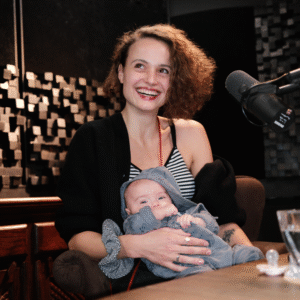
Casting director Klementyna Szymańska (and her daughter) just before the conversation with HRB’s Zosia Dudzic and Basia Karsznia.
21 November 2025
‘Casting is not about who’s the best,’ says casting director Klementyna Szymańska
Have you ever wondered exactly how Margot Robbie became Barbie, and Ryan Gosling was selected to be Ken and do beach? And how many other amazing actors auditioned for those iconic roles? In the film industry there is a name for the people who make these decisions – a casting director.
The following excerpt from the recorded interview was edited for clarity and consistency.
Barbara Karsznia (BK): Klementyna, do you ever step outside your role as a casting director, or are you constantly scanning people’s faces?
Honestly, it’s always on. I used to work with a lot of young, untrained actors, so I’ve developed this habit of subconsciously scanning faces, looking for potential. It’s not about beauty, but about charisma. You can often see a person’s character just by looking at their face.
Zosia Dudzic (ZD): You mentioned you’re a casting director ‘in the making’. How did you find your way into this career?
It was really a series of good coincidences. I’d always been connected to the film world, taking different jobs on sets while trying to find my place. Then one day, casting director Paulina Krajnik noticed me and invited me to work with her. She became my mentor and taught me a lot.
BK: What did you learn from her?
Paulina treats every casting as a meeting between two people first, and only then between an actor and a casting director. That’s something I deeply value. It’s never about judgement, it’s about creating a safe, comfortable space where actors can show their best selves. The aim is to build creative energy, not pressure.
Harbingers’ Weekly Brief
Subscribe to the Harbingers’ Weekly Brief, a newsletter written by the editorial board of Harbingers’ Magazine, the world’s youngest newsroom, delivered to your inbox every Monday morning.
![author_bio]()
![author_bio]()

![author_bio]()

ZD: People often imagine casting like it is in La La Land, a harsh room full of judges. What is it really like?
Completely different! In reality, casting is a collaborative process. Actors usually receive a scene beforehand. We meet, talk about the context, what happens before and after, and then we record. The first take is like a rehearsal. I might suggest, “Try less anger, more vulnerability.” It’s about shaping emotion, not testing memory.
ZD: How long does casting usually take?
It varies completely. Some productions take months while others start the next week. Sometimes there are five key roles and sometimes there are hundreds. Often, the main character is cast first, and then the rest of the cast. However, every project is different.
Sometimes we also do chemistry tests. For example, between romantic leads or family members, to see if the connection feels authentic. You’d be surprised how often two brilliant actors just don’t ‘click’.
BK: Would you say a casting is a competition? Does the ‘best’ actor always get the role?
Not at all. Casting isn’t a race. The question isn’t ‘Who’s best?’ but ‘Who brings this character to life most believably?’ Often, the director doesn’t even know exactly what they’re looking for until they see different interpretations in the room. It’s a creative exploration, not a contest.
Sometimes a director comes in convinced about one actor, but then another walks in and brings unexpected depth to the character. Suddenly, new layers of the story appear – that’s the magic of casting.
ZD: You’ve mentioned you’ve always been connected to performance. Did you ever want to act yourself?
As a kid, I loved performing and directing school plays, but I never had the courage to go to film school. Casting became a way to fulfill that creative side. The ‘director’ part of ‘casting director’ is very real. During auditions, I get to guide actors, explore emotions and help bring scenes to life, all without the pressure of being judged by the audience.
BK: Is there a project you are particularly proud of?
Definitely Green Border [2023] by Agnieszka Holland. It was an extraordinary experience. Everybody on set knew that they were creating something special. The subject matter was difficult, but working with all of those inspiring people made it rewarding. I doubt I will ever have another project quite like that.
ZD: You said you enjoy discovering new talents. What draws you to that part of casting?
There is something special about giving a chance to young or unknown actors. Of course, big names can make a project commercially safer, but finding someone new and helping them take their first step is the most exciting part of the job.
BK: Have you ever had a situation where a director pressured a well-known actor, but you felt some other person would be a better fit for the role?
Yes, unfortunately it happens quite often, especially in commercial films made mainly to earn money. Casting a famous actor feels safer because their name draws an audience. When you choose someone new, you don’t know if they can handle a big, complex role yet. Still, sometimes the unknown actors bring something fresher and more sentient to the production, even if it is riskier for the producers.
BK: Last question. What advice would you give to young actors who are just starting out?
Take every opportunity. Roles don’t just come to you, but you have to create chances for luck to find you. Go to every casting you can, and don’t treat rejection as failure. There are so many factors you cannot control, such as whether you look like the actor playing your parent. Often it has nothing to do with talent.
So, my advice would be to always keep going, and to learn, and to never stop trying.


This article is a part of Harbingers’ Film & Book Club, an initiative of 18 students from 2SLO in Warsaw, Poland.
Edited by:
© 2026 The Oxford School for the Future