


17-year-old Viola explains Koch’s historic achievements and her impact on young people
NASA’s recent announcement of the Artemis III crew has renewed public interest in the agency’s plans to return humans to the Moon.
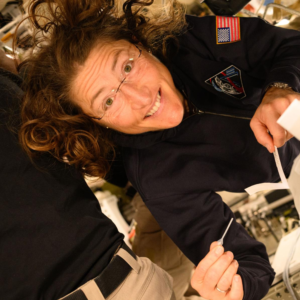
In April, Christina Koch (pronounced “Cook”), a mission specialist on NASA’s Artemis II mission, made history as the first woman to travel beyond low Earth orbit and fly around the Moon.
Her achievements mark a revolutionary moment not only in the history of space exploration but also in the advancement of women in STEM.
Harbingers’ Weekly Brief
Subscribe to the Harbingers’ Weekly Brief, a newsletter written by the editorial board of Harbingers’ Magazine, the world’s youngest newsroom, delivered to your inbox every Monday morning.
![author_bio]()
![author_bio]()


Who is she?
Koch was born on 29 January 1979 to Roland Hammock, a resident doctor, and Barbara Johnsen, a medical technician.
Growing up in North Carolina, she often worked on her grandparents’ farm in Michigan during the summer, which helped her develop the strong work ethic and endurance she later became known for.
Koch describes herself as an adventurer and explorer. Her hobbies reflect these traits, as she enjoys sailing, rock and ice climbing, photography and travelling, a passion she discovered during her exchange year in Ghana.
Besides her hobbies, she also loves spending time with her husband, Bob and their rescue dog, Sadie.
Despite her strong enthusiasm for her job, Koch always devotes time to her loved ones and favourite activities. She firmly believes that “life is long”, a phrase that has helped her to savour the moment and not rush towards her goals and dreams.
View this post on Instagram
How did she achieve her childhood dream?
Koch’s journey started at North Carolina State University, where she earned two bachelor’s degrees in electrical engineering and physics, partially funded by the Astronaut Scholarship foundation, as well as a master’s degree in electrical engineering.

Outside of her academic excellence, the encouragement she received from her teachers and parents helped to reinforce her aspirations. “No one ever discouraged the girl from North Carolina that had a dream to become an astronaut,” she recalled.
She beganher career as an engineer at NASA’s Goddard Space Flight Center. Shortly after, in 2004, she was chosento conduct research in one of the most isolated and challenging places across the globe: Antarctica.
Over the course of three years, she lived and worked far from loved ones, while having to deal with the harsh conditions of the frozen continent.
The experience of working in a space-like environment, combined with her strong professional background, helped to equip her with many of the skills essential for becoming an astronaut.
Why is she record-breaking?
Koch became an astronaut in 2013. Her milestone accomplishments include setting the record for the longest spaceflight by a woman. She spent 328 consecutive days on the International Space Station (ISS) in 2019–20.
Koch served as a flight engineer and conducted numerous scientific experiments including testing 3D biological printers and growing protein crystals in microgravity.
In total, Koch took part in six spacewalks, including NASA’s first all-women spacewalk.
“Isn’t it incredible to do things as the first women in this industry? And how much more incredible is it to have teams of women doing these things?” she saidabout the mission.
She has earned various notable prizes, including the Neil Armstrong Award of Excellence, the Global ATHENA Leadership Award and the 2026 Princess of Asturias Award for Concord. Her career reflects “humanity’s ability to overcome challenges and adversity through hard work, collaboration and empathy,” the jury said.
What is her inspiring message?
Koch is very popular with young people, especially girls, because of her inspiring personality and perspective.
In her empowering speeches and interviews, she frequently shares advice on self-doubt, ambition and perseverance, encouraging younger generations to embrace challenges, rather than fear them.
Instead of presenting herself as an extraordinary exception, Koch deliberately emphasises the struggles that were part of her journey towards success. Her aim is to ensure that her achievements never seem unattainable to young girls, reminding them that they are enough.
Koch sees her remarkable achievements as part of women’s collective empowerment. “We stand on the shoulders of those who came before us, as we mark a path for those who follow us and we cheer for them to reach even greater heights” she said.
@riverispunk Oh Christina Koch you are so inspirational #christinakoch #christinakochedit #artemis #moon #space ♬ original sound – 𝘙𝘪𝘷𝘦𝘳 𝜗𝜚
What is the viral braid photo?
A photo she took while on Artemis II, in which her braids are visible with the Earth in the background, reached millions of people when it went viral on social media.
“When I originally took the braid selfie, I saw the braid and I was like: Oh, that’s kinda in the way. And then suddenly I realised what it meant,” she explained.
On TikTok, many girls interested in STEM fields felt inspired by the picture’s symbolic meaning, because it gave them representation and motivation to continue their studies.
View this post on Instagram
Some even decided to restart their academic journey, commenting: “I reapplied to college” and “She brought back my deep passion for astronomy and physics. Trying my degree again.”
The picture also helped Gen Z in their mental health journey, with comments such as: “She makes me want to live again” and “This is my sign to dig myself out of my depression, isn’t it?”
Following Artemis II’s successful splashdown into the Pacific Ocean, returning home and seeing her loved ones again was a moment filled with gratitude and joy for Koch. However, one thing she will definitely miss about space is getting the most restful sleep of her life every night.

Edited by:

© 2026 The Oxford School for the Future