

18-year-old Ruqaiyya explains the history of modern Iran, from US ally to isolation, sanctions and war
To understand Iran today, we need to go back 70 years.
Iran’s modern history changed dramatically with the 1953 coup backed by the CIA, the US government’s foreign intelligence agency. This was a turning point that set the country on a path from Western-backed monarchy to Islamic Republic and, eventually, international isolation over its nuclear programme.
The 1953 coup
In 1951, Iran’s democratically elected prime minister, Mohammad Mosaddegh, made a key decision for the country. He nationalised Iran’s oil industry, ending decades of British control through the Anglo-Iranian Oil Company (British-owned oil company, based on a concession agreement with the Shah of Persia in 1901).
Britain persuaded the United States to intercede by playing on Cold War fears that Mosaddegh was aligning himself with the communist Tudeh Party. The US played a leading role in Operation Ajax in 1953, a secret scheme arranged primarily by the CIA with support from MI6, Britain’s secret intelligence agency, to overthrow Mossadegh and restore the power of the Shah.
View this post on Instagram
Hundreds of people died during the coup, Mossadegh was arrested and 33-year-old Shah Mohammad Reza Pahlavi – the constitutional monarch since 1941, whose powers had until then been checked by parliament and the prime minister – ended up wielding far greater authority than before.
In 1954, the new Iranian government agreement formed an international consortium with oil companies, effectively reversing nationalisation. British Petroleum held 40%, American firms received 40%, Royal Dutch Shell 14% and the French CFP the remaining 6%.
The 1953 coup ended Iran’s experiment with parliamentary democracy and reasserted Western control over oil. This felt like a win for the US and Britain, but became a traumatic experience for Iran – and cemented anti-American feelings in the country.
Modernisation and the Shah
The Western multinational consortium led by British Petroleum increased Iranian oil development. Oill revenues were to fuel the country’s economy for the next quarter of a century.
In 1963, the Shah launched an ambitious programme of societal reforms known as the “White Revolution”. It encompassed land reform, profit-sharing in industry, the enfranchisement of women and the expansion of education and rural health, but this was done unevenly. It disrupted rural life, widened social gaps and wounded vested interests.
Harbingers’ Weekly Brief
Subscribe to the Harbingers’ Weekly Brief, a newsletter written by the editorial board of Harbingers’ Magazine, the world’s youngest newsroom, delivered to your inbox every Monday morning.
![image]()
![author_bio]()
![author_bio]()


In 1957, a secret police force known as SAVAK was established as Iran’s intelligence and security agency. The organisation was seemingly above the law, with the authority to arrest any individual suspected of anti-regime activism. Dissidents were tortured and detained indefinitely, and the group became a tool of oppression, known for its brutality, turning the country into a police state.
The role of Ayatollah Khomeini
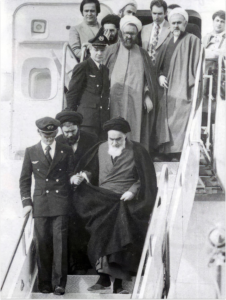
Ayatollah Khomeini’s return to Iran after 14 years in exile, 1 February 1979.
Around 90–95% of the Iranian population follows the Shia branch of Islam, unlike much of the Middle East where Sunni Muslims dominate. Shia clergy – known as the ulama – were, as scholar Azar Tabari notes, “the religious and traditional cultural leaders of society,” with Iran’s entire educational system based on clergy-run schools. These communities would later form the backbone of the revolutionary movement.
At the centre of this religious establishment was Ayatollah Ruhollah Khomeini, a Muslim cleric and the political leader of the 1979 Islamic Revolution. Khomeini was imprisoned in 1963 for his anti-government activities and denunciation of the Shah. A year later, on 4 November 1964, he was forcibly exiled from Iran. He spent more than 14 years in exile, mainly in Iraq.
Khomeini continued to speak about what he saw as the evils of the Pahlavi regime. Thousands of tapes and print copies of Khomeini’s speeches were smuggled back into Iran during the 1970s. He educated a large following while in exile, creating a strong and influential network that positioned him to play a leading role in the overthrow of the Shah.
Revolution and the Islamic Republic
By 1977, the negative effects of Iran’s rapid modernisation were clear. Political parties had been dismantled, meaningful public participation had disappeared, and political life had become increasingly closed.
In October/November 1978, the country was paralysed when civil servants, government workers and oil workers went on strike, demanding the release of political prisoners – and costing the government $60m a day.
Protests spread nationwide through the winter, and by early 1979 the Shah’s position had become untenable. On 16 January 1979, he left Iran for exile in Egypt. Ayatollah Khomeini was invited back home by the government, returning to Tehran on 1 February to a greeting by several million Iranians.
Khomeini guided the drafting of a constitution for the renamed Islamic Republic of Iran. He officially became the country’s Supreme Leader after a referendum in November 1979.
After the revolution, members of the clergy quickly excluded their former left-wing, nationalist and intellectual allies from power in the new regime, enforcing conservative social values.
The Family Protection Act (1967, amended in 1975), which had granted women more rights in marriage, was annulled. Mosque-based revolutionary groups called komītehs patrolled the streets, enforcing Islamic dress codes and delivering swift justice to those seen as enemies of the revolution.
Iran’s nuclear programme, isolation and war
Iran’s nuclear programme was established in the late 1950s, with highly enriched uranium initially provided by the United States, under President Eisenhower’s ‘Atoms for Peace’ programme. In the 1970s, the Shah announced ambitious plans for 20 nuclear reactors, with support from the West, including the US, France and Germany.
Following the establishment of the revolutionary regime in 1979, the West withdrew its backing for the UN’s nuclear programme. Following the Iran–Iraq War (1980–88), Iran resumed development with financial support from Russia and China.

In January 2002, in the aftermath of the September 11 (9/11) attacks, US president George Bush described Iran as part of the “axis of evil”. That same year, an Iranian opposition group revealed secret underground nuclear facilitiesat Natanz and Arak meant for enriching uranium and producing heavy water. It was alleged they were intended for nuclear weapons-related work, triggering an international crisis.
The UN Security Council has passed six resolutionson Iran’s nuclear ambitions since 2006, increasingly targeting the Islamic Revolutionary Guard Corps (IRGC) an elite branch that played an important role in the country’s nuclear programne.
In July 2015, during Barack Obama’s second term as US president, Iran and the world’s six major powers signed the Joint Comprehensive Plan of Action (JCPOA) to limit Iran’s nuclear activities in exchange for relief from sanctions imposed by the US, EU and UN and the unfreezing of billions of dollars in assets.
The agreement didn’t last long; in 2018, under Donald Trump’s first presidency, the United States withdrew from the JCPOA. Iran responded by boosting its uranium stockpile at all levels of enrichment, raising its 60% enriched uranium from 182 kg in October 2024 to 275 kg by February 2025.
A year later, on 28 February 20216, after failed diplomatic negotiations, Israel and US launched a joint attack on Iran, killing the Supreme Leader Ayatollah Ali Khamenei, and triggering a war that has yet to be resolved.
Iran today is a story of cause and effect, stretching back 70 years, and the coup was only the beginning.

Edited by:

© 2026 The Oxford School for the Future