


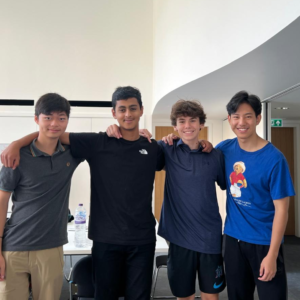
17-year-old Arnav looks back at the people, newsrooms and ideas that have shaped Harbingers’ – and where it might go next
Five years ago, Harbingers’ Magazine began with a relatively simple idea: bring together young people who believed in the power of information, and give them a place to learn how to report, question, write and think seriously about the world around them.
What followed became far bigger than that.
Today, Harbingers’ brings together contributors, writers and editors globally, alongside dedicated newsrooms in Nepal, Afghanistan and Armenia. Over the years, its wider community has reached young people in more than 40 countries, connecting teenagers whose experiences of the world can look remarkably different, but who meet in the same newsroom to make sense of it together.
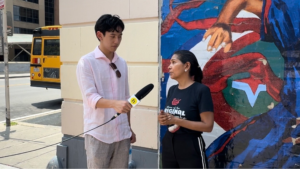
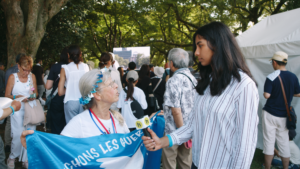
And increasingly, that newsroom has moved beyond the screen. Harbingers’ writers have reported from election rallies, international conferences and countries at war – covering Russia’s full-scale invasion of Ukraine, the 2024 US presidential election and the Munich Security Conference in 2026, to name only a few of the stories and events our writers have covered first-hand.
Harbingers’ Weekly Brief
Subscribe to the Harbingers’ Weekly Brief, a newsletter written by the editorial board of Harbingers’ Magazine, the world’s youngest newsroom, delivered to your inbox every Monday morning.
![slide image]()
![image]()
![slide image]()
![author_bio]()


Summers are a special time here at Harbingers’, because we travel internationally for journalism conferences, reporting trips and major events – including Washington, DC during the NATO 2024 Summit, and Hiroshima and Nagasaki in 2025 for the 80th anniversary of the atomic bombings. Just as importantly, they are often the first time people who have spent months working together online actually meet in person.
Around the magazine, new initiatives have grown too. The Harbinger Prize has opened another route into journalism through a global writing competition, reporting opportunities and full-ride scholarships, while the wider Harbingers’ Project has supported programmes for young people in places including Afghanistan, Latin America, Nepal, Sri Lanka and Tanzania.
Yet the idea at the centre of Harbingers’ has remained remarkably consistent. Writers are given room to make their own decisions, but never entirely on their own. As our mentors put it: “We shadow you. You make your decisions, but always with a professional’s support.”
Five years on, the clearest measure of what that philosophy has produced is not only in the places Harbingers’ has reached, but in what its writers take with them: the confidence to ask better questions; the discipline to meet deadlines; the judgement to handle information carefully; and the ability to work across cultures, even with disagreements and uncertainty.
Why keep betting on journalism?
That question has only become more difficult – and perhaps more important – over the five years that Harbingers’ has existed.
The information environment into which the magazine was born in 2021 looks markedly different today. Artificial intelligence can produce convincing text, images and videos in seconds, while social media platforms collapse reporting, commentary, advertising and entertainment into the same feed.
Misinformation no longer needs to look obviously false; increasingly, it can be polished, persuasive and difficult to distinguish from legitimate reporting.
For Tatev Hovhannisyan, Chief Editor and Academic Director at the OXSF, that does not make journalism education obsolete, but rather more necessary.
“I actually think teaching journalism has become more important because of misinformation, deepfakes and social media, not despite them,” she said.
Young people, she argues, have access to more information than any generation before them, but access is not the same as understanding. Learning journalism means learning to “stop, question, verify, look for evidence, and ask who benefits from a particular narrative”.
“These are journalism skills,” she added, “but increasingly they are also basic citizenship skills.”
At Harbingers’, that means learning through practice. Writers start with an idea, then learn how much work sits between that first pitch and a finished story: interviews, research, fact-checking, edits and. sometimes, a complete change of direction.
From students to journalists
Cath Phillips oversees Harbingers’ Editorial Board: the students who are not just writers but also editors, each of them responsible for a different section of the online magazine, whether that’s Culture, Economics, International Affairs or Society. They’re the ones who edit the reports, opinion pieces and features that are published each week.
“Learning to edit articles provides skills that are so useful in many areas of life,” she explained. You need an eye for detail, but also to be aware of the big picture. You need to be a good communicator. You need to be decisive but not hasty. You need to be sure of your own judgement but willing to listen to others.
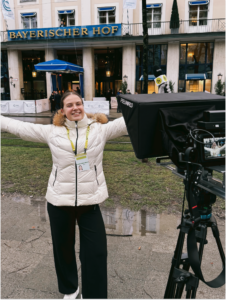
Irma Mecele at the Munich Security Conference February 2026
Cath said: “It’s wonderful to see the editors grow in confidence as they understand how to improve a piece of writing while maintaining the writer’s own voice.” A bonus is that “their own writing gets better too”.
That balance between guidance and independence is something Zuzanna Białecka sees in the writers themselves. She points to their ambition and curiosity, particularly the fact that they continue making time for journalism alongside school and other commitments.
“Every week, I open the editorial spreadsheet and find something new, something fresh,” she said. “It’s amazing how young people can impress you if you just give them enough space.”
Zuzanna also sees that development outside the newsroom. As the Project’s Multimedia Editor, she accompanies students on reporting trips around the world, watching them move from pitching and editing stories online to interviewing, reporting and working together in unfamiliar places.
For her, that curiosity is often what matters most. She describes the writers as “curious about the world” and willing to “push themselves to learn more”.
Creating room for that curiosity has also meant finding new ways to bring young writers into the newsroom.
Kimberly Yanez, Managing Editor and Programme Coordinator for the Americas, has seen something similar through the coordination of the Harbinger Prize, one of the organisation’s flagship initiatives and a major entry point for young writers into the Harbingers’ community.
Across four editions of the Prize, she has watched teenagers with very different personalities find their voice through the competition – often including those who say little in person but write with the boldest style. Many, she says, are drawn to writing not simply as another credential, but because they genuinely enjoy it.
“The ability to write on one’s own and to form unique ideas is at a premium in a world of AI,” she said.
View this post on Instagram
That will only become more important as Generation Alpha comes of age and our younger Gen Z students enter university. For Harbingers’, that shift is already beginning. The upcoming edition of the Harbinger Prize will welcome its first Generation Alpha entrants, bringing a new age group into the same process of pitching, writing and being edited.
Kimberly believes growing up in a more polarised and technology-driven information environment may leave them more sceptical than previous generations, but potentially better at questioning what they encounter. Journalism, she argues, can give that scepticism somewhere useful to go.
“The ethical implications of practising journalism could be the thing they are craving,” she said, “to filter the noise.”
Bal (Bala) Krishna Sah, the Project’s Nepali Newsroom Coordinator and a senior correspondent at the Himalayan Times, sees a related shift more broadly too. Young people, he says, are already growing up highly exposed to social media, AI and information from around the world – and increasingly see themselves not simply as audiences, but as participants in the conversations taking place around them.
“They are the major stakeholders in global conversation,” he said, arguing that young people are increasingly helping to “set the conversation” themselves.
Who gets to tell the story?
As Harbingers’ has expanded, that question has become increasingly relevant. The Project has built newsrooms and reporting initiatives in places as different as Afghanistan, Ukraine, Armenia, Sri Lanka and Nepal – and, more recently, Latin America – expanding access to journalism and giving more young people the tools, training and opportunities to tell stories from their own communities
For Bala, who works closely with the Nepali Newsroom, that comes down to context. “Without understanding context, you cannot report the actual story,” he said.
He has seen that change first-hand. Students whose first language is not English once found writing 100 words daunting; now they write 500, 600 or even 1,000 at a time, while conversations have expanded into politics, climate change and social issues. “Now, they’re unstoppable,” he said.

That same idea is shaping what comes next.
In Latin America, Carolina Loza, Spanish Newsroom Coordinator, wants to see the newsroom grow into a platform connecting young reporters across the region with the wider Harbingers’ network. “I believe in collaboration as a catalyst for growth in journalism,” she said.
Plans for the next stage include expanding in Latin America, developing and creating clearer pathways into the Project through scholarships and internships.
Five years in, Harbingers’ stands firm in its mission to expand access to world-class journalism, support young reporters and create more opportunities for underprivileged teens globally to participate meaningfully in the stories shaping their communities.
The ambition is no longer simply to report on more of the world. It is to make sure more of the world understands what young people stand for.
© 2026 The Oxford School for the Future