



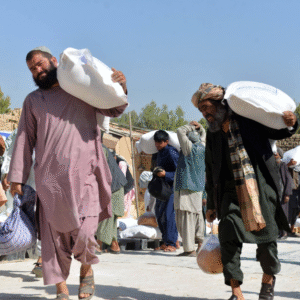
21-year-old Ghutai from the Afghanistan Newsroom analyses the problems facing both ordinary Afghans and aid organisations
In Afghanistan, humanitarian aid is a lifeline for millions, providing critical food, medicine and shelter. This year, 22.9 million people – almost half the population – require humanitarian assistance to survive, according to the United Nations.
But delivering that aid under Taliban rule is a complex, politically charged challenge shaped by strict restrictions, financial hurdles and deep ethical dilemmas.
Harbingers’ Weekly Brief
Subscribe to the Harbingers’ Weekly Brief, a newsletter written by the editorial board of Harbingers’ Magazine, the world’s youngest newsroom, delivered to your inbox every Monday morning.
![author_bio]()
![author_bio]()

Most aid funding comes from international organisations such as the UN, various NGOs and donor governments. However, recent cuts in funding, especially by the US under the Trump administration, has had a significant impact.
Also, the Taliban’s control over access on the ground has reshaped how aid is distributed – and who ultimately benefits. As well as banning or limiting female aid workers, the Taliban’s restrictions mean many women and children struggle to receive the help they need.
Marwa*, a student from a rural area, sums up the frustration many feel: “We don’t have enough support here. My cousin needs medicine, but the clinic is always empty. I wish more organisations could reach us.”
Adding to the difficulties are sanctions and banking restrictionsthat make sending money into Afghanistan a logistical nightmare. Aid groups often resort to informal cash transfers or rely on local partners to deliver supplies, a process that slows assistance and raises security concerns.
At the same time, aid agencies must tread carefully to avoid legitimising the Taliban regime, creating ethical questions about how to operate effectively without empowering a government that many consider illegitimate.
On the ground, the delivery of aid – via designated mosque distribution points and district centres – can seem inconsistent and opaque. Ahmad*, a teacher in Kandahar, said, “Aid helps many families survive, but sometimes we don’t know who will receive it and who won’t. It feels unfair.”
Lida*, a housewife, echoed this uncertainty: “I hear foreign aid is sent to Afghanistan, but my family never received anything. Maybe aid doesn’t reach ordinary families like ours.”
Harbingers’ spoke to two Afghan women, who shed further light on the reality in the country.
Parisa*, a university student from Kandahar, described the complications for women: “Women aren’t always allowed to collect aid unless accompanied by a male relative. Many sisters live alone with their children, and without a man in the family, they get no help. This isn’t fair.”
Sadaf*, a housewife, said: “My family received food aid once, during the winter of 2022 – flour, oil, beans. But after that, nothing. Sometimes when we try to get aid, staff say it’s not for us, it’s for ‘those who need it most’. But everyone who goes there needs help.”
Both stressed that essential supplies such as food, heating, medicine and school materials remain out of reach for many. They also highlighted concerns about transparency and fairness in distribution, with aid sometimes going to those with connections rather than to the most vulnerable.
As the humanitarian crisis deepens amid growing donor fatigue, these voices underscore that aid must be more inclusive, transparent and truly reach those in need. For Afghanistan to have a chance at recovery, aid delivery cannot just be about funds, it must be about fairness, dignity and hope.
*Names have been changed to protect identities.

Edited by:

© 2026 The Oxford School for the Future