

17 year-old Sonia inquires into the role of an executive producer

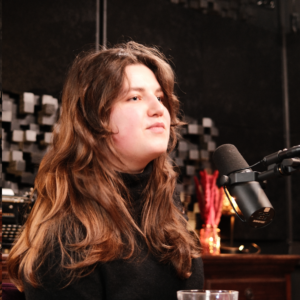
Film producer Katarzyna Stasiełuk
16 January 2026
‘In the end, the final critic is me,’ says executive producer Katarzyna Stasiełuk
Katarzyna Stasiełuk is a Polish film producer and production manager whose work is closely connected to emerging cinema, particularly within the context of the Łódź Film School and its network of student and early-career productions. Her filmography reflects a hands-on involvement in the production process across a wide range of roles, from coordination and production management to assistant producer work and on-set responsibilities.
Her projects include short feature films such as Endgame (2020), Gorzko (2024) and Egzamin (2025), as well as documentary work like My Dear Theo (2025) and Nie znikniemy (2023). Alongside these, she has contributed to numerous student productions, often taking on key organisational roles that shape the practical realisation of a film.
Stasiełuk’s work illustrates the collaborative and multi-layered nature of contemporary film production, where producers and production managers are involved in every stage of a project, from development to execution. In her case, this often means working across different formats and scales, combining creative input with logistical coordination in both fiction and documentary filmmaking.
Harbingers’ Magazine spoke to Stasiełuk about her work across these projects, the realities of early-stage film production, and the role of producers in shaping films from behind the scenes.
Sonia Rybus: Have films today become more visually valuable than narratively strong?
Katarzyna Stasieluk: For people who mostly consume films on their phones or through social media, the visual side has definitely become more important. The thumbnail, the aesthetic, the first visual impression — that’s what catches attention immediately.
But for me, as someone deeply involved in feature films and rooted in artistic cinema, both aspects must be combined. You need a strong story and a strong visual form. The visual side may attract viewers first, but the story is what keeps their attention for the entire duration of the film.
Cinema is a visual art, of course, but without a compelling narrative, it’s difficult to fully appreciate a film.
What is the biggest challenge for filmmakers today?
The most important and also the most painful stage of filmmaking is development — the first months or even years of shaping the script and the concept. I strongly believe that the longer the development process, the better the final film.

The script is crucial. After that, filmmaking is essentially about working with people. Since cinema combines many artistic disciplines, conflicts can arise — creative differences, budget limitations, or practical challenges.
Money is always an issue. Technology allows us to create bigger and more ambitious worlds on screen, but that also makes productions more expensive. Compromise is therefore central to the producer’s role. You constantly balance the director’s artistic vision with financial and logistical realities.
How is AI changing the film industry?
AI can be very helpful in filmmaking. For example, in The Brutalist, Adrien Brody’s voice was enhanced with AI so that he could sound fluent in Hungarian. For me, that’s completely fine — especially if the actor has done the work and AI simply refines the result.
We also use AI tools for breakdowns, translations, and organisational tasks. It saves time. However, I’m not a fan of AI writing scripts or replacing the creative human element. AI tools are built on human-created content in the first place.
As a viewer, AI sometimes makes me more skeptical. When I see something unusual online, I immediately check whether it’s AI-generated. That skepticism can take away some of the joy of watching. But when used responsibly in film production, AI can expand creative possibilities.
What new trend in filmmaking fascinates you the most?
I’m fascinated by how studios like A24 have changed film promotion and merchandising. They create thoughtful campaigns and unique merchandise for every release. Sometimes you see their campaigns in the street and you don’t even know at first that it’s about a movie — but it makes you curious.
Another great example was the “Barbenheimer” phenomenon, when Barbie and Oppenheimer premiered at the same time. It became a cultural event created largely by audiences online. I even watched both films back-to-back.
Promotion today is no longer just posters and trailers. It’s immersive, participatory, and everywhere. Fans create their own posters and trailers. Cinema has become more open and interactive — and that, to me, is one of the most exciting developments in modern filmmaking.
Harbingers’ Weekly Brief
Subscribe to the Harbingers’ Weekly Brief, a newsletter written by the editorial board of Harbingers’ Magazine, the world’s youngest newsroom, delivered to your inbox every Monday morning.
![author_bio]()
![author_bio]()


Has the role of film critics changed in the modern era?
Yes, I think the role of film critics has changed significantly. In the 1990s, platforms like IMDb, Rotten Tomatoes, and FilmWeb were launched, and they transformed how people discuss and evaluate cinema. Later, platforms like Letterboxd, which started in 2011, made reviewing films even more accessible to everyone.
Today, anyone can be a film critic. You just need an account to rate a movie and write a few words about your experience. Because of that, professional critics don’t influence audiences as strongly as they once did.
Personally, I don’t read many reviews before watching a film. Sometimes I’m curious about early reactions, but ultimately, the final critic is me — and my own rating.

Edited by:

© 2026 The Oxford School for the Future