


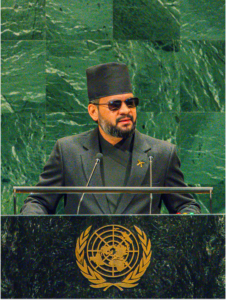
16-year-old Samuna from the Nepali Newsroom summarises PM Balen Shah’s speech at the UN General Assembly
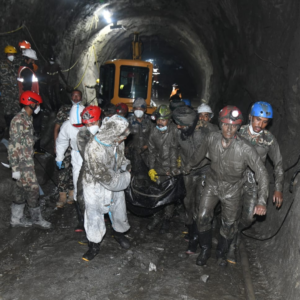
Nepal faced an apocalyptic disaster in the form of sludge, rubble, mud and deluge on 26 August. The flood damaged thousands of houses and displaced tens of thousands of people, with more than 30,000 children’s education being impacted directly.
Addressing the United Nations General Assembly in New York on 24 September, Nepal’s prime minister, Balendra (Balen) Shah, placed the recent floods at the centre of Nepal’s international message, saying the disaster had demonstrated the mounting risks faced by Himalayan communities and the wider region.
“I come before you from Nepal – a distant country in the Himalayas – carrying a close warning for humanity,” Shah told world leaders.
Harbingers’ Weekly Brief
Subscribe to the Harbingers’ Weekly Brief, a newsletter written by the editorial board of Harbingers’ Magazine, the world’s youngest newsroom, delivered to your inbox every Monday morning.
![slide image]()
![author_bio]()
![author_bio]()


He said the floods had killed more than 1,400 people and left more than 6,000 missing while causing extensive damage to roads, bridges, schools, homes, livelihoods and energy infrastructure.
“Climate change does not recognise borders,” he said, arguing that the consequences of melting glaciers, unstable mountain slopes, floods and landslides extend across national boundaries.
He warned that, if we ignore the crisis of climate change, human civilisation will have to pay a huge price. The international community must take into consideration the issue of responsibility and compensation for countries affected by climate change.
The prime minister proposed the establishment of a Himalayan Climate Resilience Mechanism, led jointly by Nepal, India and China, to strengthen regional cooperation on climate and disaster risks. Under the proposed mechanism, the three countries would share satellite information and technical expertise, monitor potentially dangerous glacial lakes, strengthen joint early-warning systems, and coordinate emergency assistance when disasters occur.
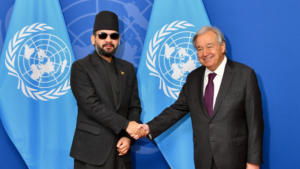
“Let the Himalayas become a laboratory of international cooperation, rather than a frontier of fragmented information,” Shah proclaimed.
Shah said Nepal needed substantial international support for recovery and reconstruction following the floods, while cautioning against relying predominantly on loans to finance recovery from climate-related disasters. He said Nepal’s preliminary assessment had placed physical recovery needs at around 10% of GDP (gross domestic product).
“When a climate-driven disaster destroys the infrastructure of a poor country, the answer cannot simply be another mega loan or a patchwork of small grants,” he said, calling for greater grant-based support.
Nepal, he stressed, contributes less than 0.1% of global greenhouse gas emissions, but is highly exposed to the consequences of a warming climate. “We did not create this crisis. Yet we are paying a colossal price for it,” Shah said.
He linked climate vulnerability directly to development, saying disasters repeatedly destroy infrastructure and livelihoods while forcing low-income countries to borrow resources to rebuild assets they had spent years developing.
A fairer global economic order
Beyond climate change, Shah used his address to question the fairness of the existing international economic and political order. He said the United Nations was founded on the principles of sovereignty, international law and human dignity, but argued that military and economic power continued to determine whose voices received attention in the international system. Nepal, he said, wanted a “much fairer global economic order.”
“Intercontinental missiles arrive on time. Rifles and ammunition cross borders, clear every bottleneck, and meet every deadline. But a peasant in Nepal cannot procure his fertiliser or fuel at market price at a time of need,” he said. “We have built a world with flawless logistics for war and broken logistics for food.”
Shah said similar concerns were faced by countries across South Asia, including Bangladesh, Bhutan, India, the Maldives, Pakistan and Sri Lanka, which he said were confronting the combined effects of climate change, economic vulnerability and conflicts beyond their borders.
Concluding his address, Shah returned to the climate crisis and the warning he said Nepal had received from the Himalayas. He called for a shift from ad hoc disaster responses toward a “culture of preparedness”, including stronger infrastructure and institutions, improved early-warning systems, climate adaptation, insurance and innovation.
He said Nepal wanted the international community to finance resilience rather than repeatedly pay for reconstruction after disasters.
“And when the next warning comes from the rooftop of the world,” Shah said, “let us be ready to hear it and ready to act.”

Edited by:

© 2026 The Oxford School for the Future