


An ongoing series of heatwaves has affected all of Europe, with major wildfires also breaking out in France, particularly in the south-west around Bordeaux, but Spain has been particularly badly hit.
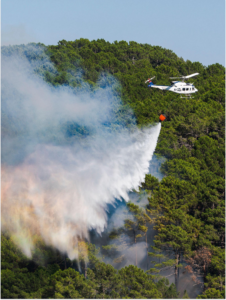
Fire-fighting helicopter in La Adrada, near Madrid, 24 July 2026.
A series of devastating forest fires have swept through Spain this summer, destroying thousands of hectares and affecting thousands of people, many of whom have lost homes and businesses or been evacuated.
The worst conflagrations occurred in the Comunidad de Madrid,and lasted from approximately 23 to 29 July. Other major fires took place in Ávila (Castilla y León), Toledo (Castilla-La Mancha) and Almería(Andalucía), among others.
To combat the issue, on 23 July Spain’s president Pedro Sánchez declared a national emergency due to forest fires for the first time in the country’s history.
This meant the central government assumed control, allowing them to coordinate a unified national response to the wildfires and deploy emergency crews to bring the fires under control. The state of emergency was lifted on 30 July, when the authorities declared the fire “stabilised”.
The Spanish government has also released new plans to prevent and fight forest fires in Spain. The main one (Plan de Prevención y Lucha contra los Incendios Forestales 2026), unites state ministries, military units and regional civil protection services to counter extreme heat and wildfires. It includes the deployment of six new helicopters and 15 amphibious airplanes.
Additionally, a new royal decree-law covers extraordinary labour measures, allowing workers directly affected by the wildfires to temporarily suspend their employment contracts while receiving specialised emergency benefits.
The reasons for the forest fires can be attributed to climate change and this summer’s Europe-wide heatwaves in particular. According to the World Wildlife Fund (WWF), although the overall number of fires in Spain has fallen by 33% compared with the average for the last decade, the burned area has increased by 8%.
View this post on Instagram
Human negligence and changes in the landscape, such as more villages and housing near forests, are also considered factors.
When it comes to fighting wildfires, Spain is also using specialised teams to collaborate with local communities and park rangers, to prevent fires in the first place. These teams teach rural residents how to safely manage land, clear brush and conduct controlled burns.
After the devastating flooding in Valencia in October 2024, which was caused by a weather phenomenon known as DANA (Depresión Aislada en Niveles Altos), the Comunidad Valenciana government created an emergency education plan.
This mandatory school curriculum is designed to teach students how to respond to natural and man-made disasters. After this summer’s forest fires, the authorities have announced that it will include fire prevention now too.
Spain has also created a constantly updated fire danger index for the whole country, which shows the likelihood of a fire occurring, ranging from very low to extreme. It is similar to the information systems that are used in Canada and parts of the US.
Harbingers’ Weekly Brief
Subscribe to the Harbingers’ Weekly Brief, a newsletter written by the editorial board of Harbingers’ Magazine, the world’s youngest newsroom, delivered to your inbox every Monday morning.
![author_bio]()
![author_bio]()


When it comes to how Europe is preparing, The European Forest Institute (EFI), a Europe-wide organisation focused on forest research and knowledge-sharing, has released a statement. It touches on reasons for extreme wildfire events, and calls for a new approach against forest fires – not to promote one model, but to create diverse and resilient landscapes adapted to local conditions.
The EU Council’s policy recommendation on integrated wildfire risk management, launched in March 2026, is now being implemented.

Edited by:

© 2026 The Oxford School for the Future