


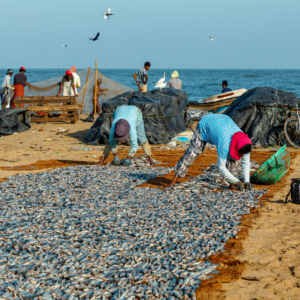
17 -year-old Lisindi from the Sri Lankan Newsroom explores how bottom trawling has affected Sri Lanka’s fishing industry
Bottom trawling has been illegal in Sri Lanka since 2017, but every day hundreds of Indian trawlers enter northern Sri Lankan waters, depleting resources and putting the livelihoods of Sri Lankan fishermen at risk.
According to the Ministry of Fisheries, 500 of these vessels cross the Sri Lankan border daily, each boat capturing 1,000 kg of fish and prawns.
Forty years ago, the Palk Strait and Gulf of Mannar, the shallow waters that separate the Indian state of Tamil Nadu from northern Sri Lanka, were rich fishing grounds that sustained coastal communities.
Harbingers’ Weekly Brief
Subscribe to the Harbingers’ Weekly Brief, a newsletter written by the editorial board of Harbingers’ Magazine, the world’s youngest newsroom, delivered to your inbox every Monday morning.
![slide image]()
![author_bio]()
![author_bio]()


This changed during Sri Lanka’s 26-year-long civil war (1983–2009), which mainly affected the island’s Northern Province, where fishing activity was highly restricted. As a result, the population of fish in Sri Lankan waters increased exponentially, while overfishing by Indian trawlers severely depleted the population of fish in Indian waters.
After the restrictions were lifted, hundreds of mechanised bottom trawlers from Tamil Nadu started encroaching into Sri Lankan waters. Mr Annarasa, a fisherman from northern Sri Lanka, said in 2021: “We have lost around 40% of our daily fish catch due to bottom trawling by Indian fishermen.”
High-powered bottom trawlers use heavy ground ropes and chains to drag a wide, cone-shaped net along the ocean floor. This permanently damages the sea bed leaving only mud in its path, while the net indiscriminately scoops up marine organisms.
The method mostly impacts ground fish, specifically green tiger prawns, squid and sea cucumbers. Moreover, 80–90% of the catch consists of species that is not wanted by fishers, which is then thrown back into the sea as waste.
Sri Lankan navy officers have noticed that Indian bottom trawlers tend to appear on Mondays, Wednesdays and Saturdays. This became an established pattern due to a rotational agreement between Indian small-scale fishers and trawlers made in the 1990s.
When Indian trawlers are tracked in Sri Lankan waters, mostly near the IMBL (International Maritime Boundary Line), the Sri Lankan navy deploys fast attack craft to chase away or apprehend the boats. If the trawlers resist, the navy boards the vessel, seizes the trawlers and arrests the fishermen.
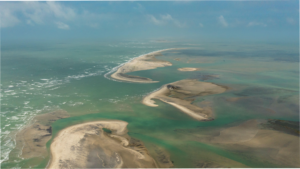
In late July, 50 Indian trawlers trespassed into Sri Lankan waters. The navy seized one of the boats and took the nine crew into custody.
To evade arrest, the Indian fishermen have been known to behave aggressively, throwing hot water, broken glass or oil on the deck and even taking hostages. Harbingers’ Magazine interviewed Sri Lankan navy captain YR Edirisinghe, who said: “Bottom trawlers often pour oil on the decks of the ships and many navy officers get injured because of this.”
Environmental impact
Bottom trawling has brought severe environmental consequences to Sri Lankan waters, especially to shallow areas. The depth of the sea in the Palk Bay and the Gulf of Mannar is 12–14m. This make these areas especially vulnerable to destruction. The trawlers’ heavy nets and iron chains destroy everything in their path, including delicate reef ecosystems.
Using bottom trawlers is very wasteful, as most of the catch consists of unwanted fish, threatened species or inedible marine animals, which are discarded and thrown back into the sea. Endemic species, such as dugongs and sea turtles, including the olive ridley turtle, are also caught and killed by the trawlers.
Lastly, the damage to the sea floor releases high levels of carbon dioxide into the atmosphere, ultimately contributing to climate change.
Marine ecologist Dr Turney Pradeep Kumara, professor of oceanography at Sri Lanka’s University of Ruhuna, stated: “From an environmental perspective, it is totally devastating to the coastal and shallow water ecosystems.
“Fish resources will die out because sea grass and corals, which are the cradles of marine biodiversity, will be uprooted. When you remove them, you remove the base of the food pyramid, so not only are you destroying the species you are destroying the regeneration.”
Economic impact
Illegal bottom trawling has also had a devastating economic effect on Sri Lanka’s fishing industry.
The country is reportedly losing about 350 million rupees ($1 million) per day as a result of the illegal activities of Indian trawlers in the northern seas. These actions have caused permanent damage to fish stocks, affecting the income levels of thousands of fishermen and harming the entire fishing industry in Sri Lanka.

Boats and nets are destroyed as a result of the trawling operations, pushing those who struggle financially into more debt. “Some of my friends have taken their lives because the dwindling catch is leaving them bankrupt,” said K. Padmasiri, a fisherman from Nainativu.
Many Indian fishermen have proposed that if it is not possible to fish in Sri Lankan waters, they should be given compensation or alternative employment opportunities. Sri Lankan fishermen, on the other hand, have been adamant about completely stopping bottom trawling.
“The trawler fishermen of Palk Bay, from Nagapattinam to Rameswaram [in Tamil Nadu], are not a homogeneous group – they come from various religious and social backgrounds, with differing levels of connection to the sea,” said V. Vivekanandan, the secretary of India’s Fisheries Management resource centre.
Mr Vivekanandan noted that a common demand among Sri Lankan fishermen is that Indian fisherman should be given special licences to fish in Sri Lankan waters for only two days a week instead of the current three-day system.
While the issue has persisted due to Sri Lanka’s diplomatic reliance on India, Sri Lankan authorities insist that action is being taken. A high-level delegation, led by fisheries minister R. Chandrasekar, is scheduled to visit India in late September for official talks on the dispute.
Speaking to the media in early September, Minister Chandrasekar said that the government wished to “end the ongoing illegal fishing by Tamil Nadu fishermen at the expense of northern fisherfolk”.

Edited by:

© 2026 The Oxford School for the Future