

18-year-old Ryleigh explores the financial barriers to tertiary education in the Philippines
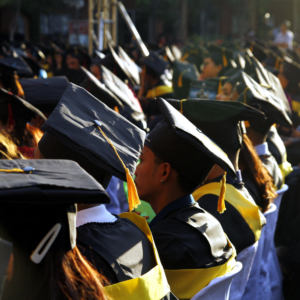
With graduation season rolling in for many countries in Southeast Asia, many students will be faced with the same old question: “What university are you going to?” Some may have an answer prepared, others may be undecided. But a number of students face a different dilemma: “Will I even go to college at all?”
Young people from privileged backgrounds have the opportunity to enroll in private universities, while less wealthy individuals opt for state universities and colleges (SUCs) subsidised by the government. However, the cost of higher education is rising sharply around the world, meaning that it is increasingly a luxury that only the comfortable and capable can enjoy.
Harbingers’ Weekly Brief
Subscribe to the Harbingers’ Weekly Brief, a newsletter written by the editorial board of Harbingers’ Magazine, the world’s youngest newsroom, delivered to your inbox every Monday morning.
![slide image]()
![author_bio]()


In the Philippines, tuition fees for private universities continue to rise at an alarming rate alongside inflation, with proposed increases of 2–10% in 2026. Average tuition fees are 130,000 Philippine pesos (c. $2,100) per academic year, so an increase on this scale would be incredibly high for students’ and their families.
The average annual income for a Filipino family with four members is 353,000 PHP (c. $5,700), with average expenditure at 258,000 PHP (c. $4180).
Tuition fees are rising elsewhere in the region too. In Vietnam, fees have increased an average of 10%. Likewise, over the past 20 years Singapore’s tuition rates have been rising by an average of 2.68% a year, higher than the core inflation rate of 1.88%.
Tuition fees aren’t the only expense a university student has to worry about, of course. Food, transportation, living costs and other expenses have continued to rise across Southeast Asia, with inflation this year averaging 3.3.%.

Rises in the cost of living continue to undermine any economic progress made, impacting various aspects including higher education, accordingto the Asian Development Bank.
Furthermore, economic deprivation inhibits students from pursuing higher education, as seen in lower enrollment ratesin, for example, Cambodia (12.98%) and Laos (13.48%) compared with the Philippines (33.37%) and Singapore (93.13%).
Students from foreign countries also suffer from higher education costs in Southeast Asia, as regulatory bodies cause further financial strain for both institutions and students. For example, in 2025, the Malaysian government imposeda 6% tax on tuition fees for international students in private education.
Problems of state education
Many students in Southeast Asia have the option to attend SUCs, but these are exclusive and competitive, selecting applicants through merit-based systems that inevitably favour privileged students with access to better educational resources.
Moreover, SUCs are limited by low budgets, which have decreased even further thanks to recent budget cuts. In the Philippines, SUCs’ budgets for 2026 were cut by 6.8bn PHP ($113.6m).
Rein Ignacio, 18, spoke to Harbingers’ about the problems of competing for a coveted spot at an SUC. He said you have to devote your “soul” to remain competitive.
“Although the number of applicants has increased, the number of slots on courses are constant because of the limited budget provided by the government, and the strain on university instructors and professors,” Rein explained. As a result, SUCs are forced to reject the majority of applicants.
View this post on Instagram
Inadequate government funds
Government subsidies provided as boosts for students are insufficient to cover both tuition and living costs. This issue is prevalent all across Southeast Asia and increases financial anxiety among students.
For example, in Vietnam, only 0.9% of the government’s total spending is allocated to higher education. Household incomes contribute 57% to public universities’ revenue, with only 24% covered by the national government.
Even in Singapore, where government subsidies are substantial, annual course fees for students at public universities are $8,300–13,500.
As a result, students have been forced to shift their focus towards courses they can afford, setting aside their dreams for cheaper and more practical ones.
Jeremy Nario, an 18-year-old Filipino student, shared with Harbingers’ his experience as an underprivileged student aiming to enter tertiary education. He said:
“Growing up, becoming a lawyer was a dream of mine. But as I grew up and saw my parents’ hardship, I knew I had to let go of that idea because of the expense.”
“From a kid who just thinks about what he wants, I had to be more financially conscious,” Jeremy said. “ I’ve learned I have to prioritise needs and leave my wants and dreams.”
A silver lining
The Philippine government is trying to increase accessibility to SUCs and higher education in general through laws such as the Universal Access to Quality Tertiary Education Act (UAQTEA) of 2016.
Whenzy Galang, a government councillor and activist, talked with Harbingers’ about making public tertiary education more open for students from all walks of life.
“Overall, the scope and impact of this [UAQTEA] remains limited. The root of SUCs’ issues is the chronic lack of government funds,” Galang explained.
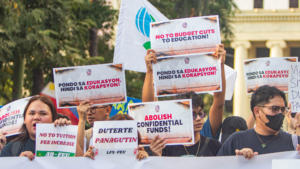
“It’s clear that the first step would be to significantly raise the budget [for SUCs], aligned with their actual needs. Moreover, access to education should be more democratised. Meaning, strict admission policies shouldn’t be obstacles if the true goal is to widen education access for all,” she added.
If such changes were made, there is hope for a brighter future for many more students to enjoy their right to higher education – not as a luxury or privilege, but their true right, made not only for their future but for all of society.

© 2026 The Oxford School for the Future