


16-year-old Irma examines the European and North American alliance shaping global security
Welcome to a new series that breaks down international affairs for young people and anyone curious about how the world works.
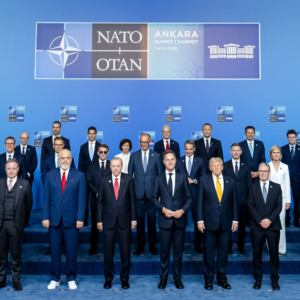
We are starting with NATO, one of the most influential international organisations in the world. It has shaped European and global security for more than 75 years.
Understanding NATO can help us make sense of international politics, defence and cooperation between nations.
Harbingers’ Weekly Brief
Subscribe to the Harbingers’ Weekly Brief, a newsletter written by the editorial board of Harbingers’ Magazine, the world’s youngest newsroom, delivered to your inbox every Monday morning.
![slide image]()
![author_bio]()
![author_bio]()


What is NATO?
NATO (full name: North Atlantic Treaty Organization) is a political and military alliance made up of 32 countries. It was officially founded on 4 April 1949 when 12 countries signed the North Atlantic Treaty in Washington, DC.
The organisation’s primary purpose is to protect the security of its member states. NATO allows countries to work on defence and crisis management while promoting democratic values.
The key principle of NATO is collective defence, which is stated in Article 5 of the North Atlantic Treaty. This means that an attack against one member is considered an attack against all members, triggering an obligation for other members to come to its assistance, which may potentially include the use of armed force.
Article 5 has only been invoked once, after the 9/11 attacks against the US in 2001.
View this post on Instagram
Why was it created?
NATO was established after World War II, when much of Europe had been devastated by the conflict. Millions of people had died, cities were destroyed and economies were struggling to recover.
Historians generally identify three main reasons for NATO’s creation: to deter Soviet expansion and the spread of communist ideology in Europe; to prevent the resurgence of militarism that had contributed to the two world wars; and to strengthen political and security cooperation between North American and European democracies.
How does it work?
NATO works through political and military cooperation.
The alliance allows member countries to discuss security issues, share information and coordinate policies. Decisions are made by consensus, meaning all members must agree before action is taken.
While NATO prefers peaceful solutions, it maintains military forces to defend its members if needed. Although NATO itself does not have its own army, member states can still take appropriate military action collectively during international crises.
It can also carry out peacekeeping, crisis management and humanitarian missions.
Who are NATO’s members and how can countries join?
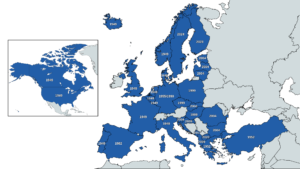
Currently, NATO is made up of 32 countries in Europe and North America.
The organisation was founded by 12 countries: Belgium, Canada, Denmark, France, Iceland, Italy, Luxembourg, the Netherlands, Norway, Portugal, the United Kingdom and the United States.
Since its creation, NATO has expanded through several rounds of enlargement. Greece and Türkiye joined in 1952, followed by Germany in 1955 and Spain in 1982. After the end of the Cold War, Czechia, Hungary and Poland joined in 1999.
In 2004, Bulgaria, Estonia, Latvia, Lithuania, Romania, Slovakia and Slovenia became members. Albania and Croatia joined in 2009, Montenegro in 2017, North Macedonia in 2020, Finland in 2023 and Sweden in 2024.
Under Article 10 of NATO’s founding treaty, any European country can apply to join if it supports the alliance’s principles and can contribute to NATO’s security. However, joining is not automatic. Every existing NATO member must agree before a new country can be admitted. This means that a single member can block or veto the application.
What role does NATO play in international relations?
NATO serves as both a military alliance and political forum. It helps maintain stability by encouraging cooperation between countries and deterring military aggression.
The alliance works closely with organisations such as the United Nations (UN) and the European Union (EU), while also partnering with non-member countries. NATO has also taken part in peacekeeping, counter-terrorism and security missions. For example, it has been involved in peacekeeping in Kosovo in the Balkans since 1999.
What are NATO’s priorities?
Since Russia’s full-scale invasion of Ukraine in 2022, strengthening NATO’s eastern border has become one of the alliance’s central priorities. NATO has increased its military presence in countries bordering Russia and Belarus, expanded defence planning and improved military readiness.
In recent years, NATO has also broadened its focus beyond traditional military threats by addressing the security impacts of climate change, cyberattacks, emerging technologies, and growing geopolitical competition with China.
Who is critical of NATO?
NATO has faced criticism from different groups and countries. Some critics argue that NATO has occasionally gone beyond its original defensive purpose; for example, the alliance’s interventions in Kosovo (1999) and Libya (2011) remain controversial.

Russia has long criticisedNATO’s expansion into eastern Europe, claiming it threatens Russian security. President Putin, in particular, has spoken outagainst NATO’s expansion and Ukraine potentially becoming a member state. But NATO argues that countries freely choose whether to join the alliance.
President Trump has also been highly criticalof NATO, particularly over its refusal to get involved in the US’s war in Iran, and has threatened to withdraw from the organisation.
Another longstanding debate is about burden sharing within the alliance. The United States has contributed a larger share of the alliance’s military resources, but members have committedto increasing their spending to 5% of GDP by 2035.
Some critics believe European members should spend more on defence, while others argue military spending should be reduced overall.

Edited by:

© 2026 The Oxford School for the Future