


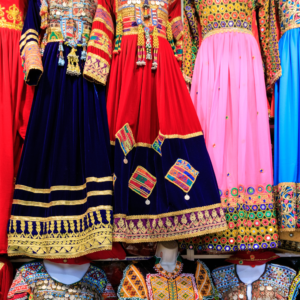
18-year-old Hadiya from the Afghanistan Newsroom explores the private world of fashion in today’s Afghanistan
On a Kabul street, the city moves in a palette of black: women wear abayas (robe-like garments) and face veils, their footsteps quick and eyes lowered. But step through a wedding hall’s mirrored doors and the scene flips – skirts bloom like flowers after rain, emerald and fuchsia flash under chandeliers, and the room hums with the soft clink of bracelets. Public uniformity, private colour: Afghanistani women live inside that contrast every day.
Afghanistan’s traditional dress has always provided a map of the country’s regions. Kuchi-inspired outfits swing with coins that chime when their wearer laughs. Hazara and Tajik ensembles sparkle with dense embroidery and mirrorwork. Pashtun gowns tend to use bold, vibrant colours – ruby, saffron, lapis – with bodices stitched in patterns that have been passed down like lullabies.
View this post on Instagram
At weddings, women still arrive in their “best language” – garments that name hometowns and lineages before a single word is spoken. Guests dress as custodians of craft, layering jewellery and heirloom textiles to honour the occasion.
Outside such settings, however, the rules are different. Since returning to power in 2021, the Taliban authorities have tightened public dress codes: orders to cover the face in public and directives enforced by morality patrols, with penalties that can extend to a woman’s male guardian.
United Nations monitors have reported campaigns of inspections and detentions over hijab violations in Kabul and Daykundi. Human rights groups also document how these dress rules sit within a wider web of restrictions on movement, work and education for women and girls.
Harbingers’ Weekly Brief
Subscribe to the Harbingers’ Weekly Brief, a newsletter written by the editorial board of Harbingers’ Magazine, the world’s youngest newsroom, delivered to your inbox every Monday morning.
![author_bio]()


And so private events – weddings, birthdays, house parties – become places of sartorial relief. Behind separate entrances and curtained windows, fashion moves from compliance to conversation.
Here, a cousin’s sleeve is admired not only for its hand-stitched gul-e-buta motif but for the story it carries: a grandmother’s pattern revived; a tailor found through a friend-of-a-friend; hours stolen from the week to choose a lining that feels like a secret. In these rooms, women try things on – styles, selves, futures – and their reflection smiles back without asking permission.
Lately, the fantasy has widened. Alongside richly traditional looks, European-style and fairytale gowns float across dance floors: tulle that drifts like fog, corseted waists, off-the-shoulder necklines, pearl-studded veils. Not just for brides – guests, too, lean into glamour.
The most telling looks are hybrids. A midnight tulle skirt paired with a hand-embroidered bodice; a princess cut edged with Kuchi coins; a sleek satin column anchored by a Hazara belt.
These blends aren’t accidents of taste – they’re declarations. They say: I belong to my grandmother’s thread and my own timeline. I can be classic and modern, or modest and magnificent. The garment becomes a negotiation between outside rules and inner desire, between what is asked and what is wanted.
In a climate where visibility is rationed, fashion is not only adornment – it’s archive and argument. Every mirrorwork panel preserves a local stitch that might otherwise go quiet. Every gown chosen for a private celebration reasserts a personhood that public life tries to narrow.
Afghanistani women are not shouting here; they are sewing. Yet the message carries: we will be seen on our terms – if not in the street, then in the stories our clothes tell and the rooms where we let colour breathe. Quiet resistance, vivid wardrobe.

© 2026 The Oxford School for the Future