



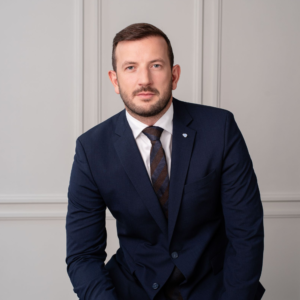
16-year-old Irma interviews Virginijus Sinckevičius about the role of youth in politics
Virginijus Sinkevičius has built a successful political career at an unusually fast speed. At 35, he holds multiple records as the youngest person to occupy some key political posts in Europe. Today he serves as a Member of the European Parliament, vice-president of the Greens group and vice-chair of the Transport and Tourism Committee.
“I came into politics when I was elected [to Lithuania’s parliament, Seimas] for the first time in 2016. At that time, I was 25 [the minimum age to run for the position],” he told Harbingers’ Magazine.
Within a year of entering parliament, Sinckevičius became chair of the parliamentary committee on economics. Just a year later, he was appointed Minister of the Economy – the youngest in Lithuania’s history. He served in this role for two years, then, at the age of 28, he was appointedEU commissioner for the environment, once again becoming the youngest person to ever hold the position. He became an MEP in 2024.
Despite his achievements, Sinkevičius acknowledges the widespread stereotype that young politicians lack credibility and are taken less seriously than their older and supposedly more experienced counterparts. He aims to challenge that perception.
“It’s easy to assume that when you are young and you walk into a room full of older people, you will be treated with less respect,” he says. “That has not been my experience. On the contrary, people listen and value your opinions, but you have to be very well prepared.”
Preparation, he emphasises, is key. Reflecting on the early stages of his career, Sinkevičius recalls spending “long hours of reading, learning, thinking about direction, how to achieve it, and speaking with stakeholders.” Arguments, he says, must be carefully thought-through. “A young politician has the same advantages as an older politician.”
He argues that youth itself can be a strength. “Young politicians have a big advantage with the energy and the enthusiasm that they possess,” he says. “They are energised by their ideas and that’s super beautiful. It has a lot of convincing power.”
One of the most common criticisms young politicians face is that they are not old enough. Sinckevičius sees this as a sign of success rather than weakness.
“If your political opponent says your disadvantage is your age, that’s the best argument you can hear,” he says. “It means everything else is great, and age is something you cannot change.”
When critics focus on age instead of policy issues such as welfare, investment or the environment, he believes it signals a lack of substantive criticism. “If age is the only argument they have,” he says, “then I know I am winning the debate.”
Young leaders of today
Sinckevičius also strongly rejects the idea that young people are merely “future leaders”. “What does ‘future’ even mean?” he asks. “Too often, young people are treated as leaders of tomorrow, rather than the leaders of today – and that’s the wrong approach. You should run for positions now. If you are elected, you have a democratic mandate today.”
To reach younger audiences, Sinckevičius actively uses social media. “You have to go where young people are,” he says, emphasising that this goes beyond old-school platforms such as Facebook or X to TikTok and Instagram.
Harbingers’ Weekly Brief
Subscribe to the Harbingers’ Weekly Brief, a newsletter written by the editorial board of Harbingers’ Magazine, the world’s youngest newsroom, delivered to your inbox every Monday morning.
![author_bio]()
![author_bio]()


Earlier this year, he launched a YouTube podcast, featuring Lithuanian public figures and celebrities. Still, he draws a clear line between a politician and an influencer: “When politicians become too silly, they lose the ability to communicate serious policy.”
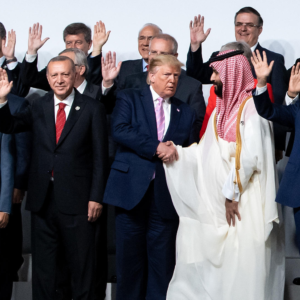
He also warns about the broader danger of social media, arguing that it has produced a new type of political figure. “You have Trump on one side and Mamdani on the other – both are products of social media,” he said.
View this post on Instagram
Such figures, he argued, gain mass support by understanding algorithms and digital engagement, a trend visible wherever smartphones are widespread.
According to Sinckevičius, the deeper problem lies in the algorithms that limit exposure to diverse viewpoints. Social media feeds often reinforce existing beliefs, creating echo chambers and intensifying polarisation. He pointed to Chile’s recent presidential election, where voters were left choosing between two extreme candidates. “I don’t think that’s healthy for a society,” he says.
Despite these challenges, Sinckevičius strongly encourages young people to engage in politics. “Be courageous. Fight for your ideas. If you believe in something, don’t be afraid to defend it – even when you hear ‘no’. Debate it.”
“Don’t be a future leader,” he concluded. “Be a leader today.”

Edited by:

© 2026 The Oxford School for the Future